Thursday, March 27, 2014

March 26th WHMonth: MEN'S HEALTH ISSUES - HEALTHY HEART / HI BLOOD PRESSURE

TO CELEBRATE WOMEN'S HISTORY MONTH (WHM), during the month of March ~ in addition to my weekly postings ~ I will be making DAILY postings of time tested herbal and medicinal foods used from a Medicine Woman's bag, which holds many, many herbs, generating many, many formulas, as one herb used for a cold (mullein), when combined with totally different herbs, can be used as an antispasmodic for inflammation or as an expectorant to relieve asthma or general lung congestion.

Sex Symbols I : Stock PhotoThis last week of March I will dedicate to OUR MEN.  Women's History Month would not be complete without addressing some health and healing issues for our men. During the 4+ years that I've been writing my weekly column on herbs and healing alternatives, most of my articles have been for men and women alike, but most specific articles are usually directed towards women's issues.  Yes, we have more health concerns then men, but this last week will focus on male issues - though ironically, out of the top ten causes of male deaths, only one is male organ specific: prostate cancer.  The other nine are suffered by women as well, but happen less frequently to women than men. 


My beloved Fathers, Brothers and Uncles, I am happy that we have begun to make better health and lifestyle choices. We will be looking at diet, herbs and lifestyle alternatives to address the top five killers of men: today cardiac herbs for the heart and blood pressure.  I am currently creating a “Health Detox and Regeneration Regimen” of herbs and whole-food supplements that will drastically raise your energy level and have a marked improvement on your bodies' ability eliminate and manage disease.

Although heart disease is the leading killer of both men and women, almost twice as many males die of cardiovascular conditions than women.  According to the CDC, one in four men have some form of heart disease.  Herbs for the lungs/heart/hypertension include comfrey root, horehound, elecampane, ginger, hawthorn berries, cayenne, black cohosh, skullcap, senega root, lily of the valley, tien chi, motherwort, rehmania, garlic, sanicle, sassafras.

Slippery Elm Bark - unmatched in its nutritive properties
especially for the Elderly!!!
For debilitating lung congestion, bronchitis, or chronic cough take 2-3 cups daily of either of these hot herbal tea formulas:

1. Combine 2pts slippery elm bark, 1pt each horehound, thyme, red clover, yerba santa, lobelia, 1/8 pt cayenne (severe lung problems).

2. Combine equal parts pleurisy root, elecampane root, mullein, yerba santa(chronic lung)

3. Combine yerba santa, wild cherry bark, licorice root and elecampane.

4. Combine 2pts motherwort herb, 1pt hawthorn berries, ½ pt valerian (good heart tonic).

People who consume soft drinks such as Coke have a 48% increase in heart attack and stroke risk, compared to people who did not drink the sodas at all or did not drink them every day. A study published in the journal Respirology, reveals that soft drink consumption is also associated with lung and breathing disorders including asthma and chronic obstructive pulmonary disease (COPD).

Cayenne Pepper - unmatched
in harmonizing blood pressure!!!
As a way to manage your blood pressure, herbs and spices are a fantastic way to increase the medicinal value of your food. Below are some herbs and spices you may have been enjoying with no idea as to their value:

1. Garlic - Garlic contains allicin, a substance which has antibacterial, antioxidant, lipid lowering and anti-hypertension properties.

2. Cinnamon - Cinnamon not only prevents heart disease, it can also prevent diabetes.

3. Onions - Onions contain quercetin, an antioxidant flavonol found to prevent heart disease and stroke.

4. Olives - Oil made from olives has been found to reduce blood pressure.

5. Oregano - This herb contains the compound carvacrol which has been proven to be effective against blood pressure.

6. Hawthorn - This herb has been traditionally used to treat high blood pressure.

7. Cardamom- In one study was able to demonstrate that blood pressure was effectively reduced.


Wednesday, March 26, 2014

March 25th WHMonth: MEN'S HEALTH ISSUES - LUNG CANCER

TO CELEBRATE WOMEN'S HISTORY MONTH (WHM), during the month of March ~ in addition to my weekly postings ~ I will be making DAILY postings of time tested herbal and medicinal foods used from a Medicine Woman's bag, which holds many, many herbs, generating many, many formulas, as one herb used for a cold (mullein), when combined with totally different herbs, can be used as an antispasmodic for inflammation or as an expectorant to relieve asthma or general lung congestion.

Sex Symbols I : Stock PhotoThis last week of March I will dedicate to OUR MEN.  Women's History Month would not be complete without addressing some health and healing issues for our men. During the 4+ years that I've been writing my weekly column on herbs and healing alternatives, most of my articles have been for men and women alike, but most specific articles are usually directed towards women's issues.  Yes, we have more health concerns then men, but this last week will focus on male issues - though ironically, out of the top ten causes of male deaths, only one is male organ specific: prostate cancer.  The other nine are suffered by women as well, but happen less frequently to women than men. 


MEN'S HEALTH – Men, let's begin to make some SERIOUSLY SIMPLE choices. This week we are looking at diet, herbs and lifestyle alternatives to address the top five killers of men:  cardiac herbs (for hypertension and stroke), urinary tonics for the prostate, pulmonary herbs for the lungs and herbs for cancer, and depression. The previous article covered prostate health, this one will cover cardiac herbs (for lung cancer, hypertension and stroke).

Lung cancer is the leading cancer killer of both men and women, claiming more lives than prostate, colon, and breast cancer combined. The good news is that rate of new lung cancer cases has been dropping since the 1980s, and deaths from the cancer have fallen since the 1990s. "That is because of the drop in the prevalence of the use of tobacco products by men that followed the Surgeon General's report in 1964."
Besides smoking, the American Cancer Society lists the following as risk factors for lung cancer: exposure to secondhand smoke, exposure to asbestos or radon, personal history, air pollution, and tobacco products (which are responsible for 90% of lung cancer, which puts the weight of prevention efforts on stop smoking). 

Herbs for the lungs/heart/hypertension include comfrey root, horehound, elecampane, ginger, hawthorn berries, cayenne, black cohosh, skullcap, senega root, lily of the valley, tien chi, motherwort, rehmania, garlic, sanicle, sassafras.


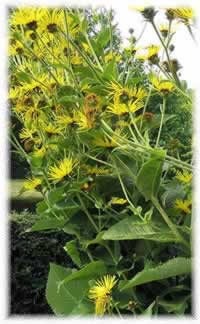
Inula helenium  ELECAMPANE - Elecampane is an herb whose root is used medicinally. Elecampane is used for lung disease including asthma, bronchitis, and whooping cough. It is also used to prevent coughing, especially coughing caused by tuberculosis; and as an expectorant to help loosen phlegm, so it can be coughed up more easily.

HAWTHORNE BERRIES - Hawthorn leaves, berries, and flowers are used to make medicine.  Hawthorn is used for diseases of the heart and blood vessels such as congestive heart failure (CHF), chest pain, and irregular heartbeat. It is also used to treat both low blood pressure and high blood pressure, “hardening of the arteries” (atherosclerosis), and high cholesterol. 

SANICLE - Astringent, alterative. Sanicle is usually given in combination with other herbs in the treatment ofblood disorders, for which it is in high esteem. As an internal remedy, it is of great benefit in all chest and lung complaints, chronic coughs and catarrhal affections, inflammation of the bronchii, spitting of blood, and all affections of the pulmonary organs.  As an alterative, it has a good reputation, and it is useful in leucorrhoea, dysentery, diarrhoea, etc.  It effectually cleanses the system of morbid secretions and leaves the blood healthier and in better condition. The infusion of 1 OZ. to a pint of boiling water is taken in wineglassful doses.


TIEN CHI - In traditional Chinese medicine, tienchi ginseng was used to reduce bleeding, decrease pain, reduce high blood pressure and reduce harmful cholesterol in the blood. It also was believed to reduce heart disease.
Today, there is a great deal of research that suggests that tienchi ginseng is a key part of the diet to optimize our circulation and to boost our defense system. People who take this form of ginseng for many years report amazing benefits in both the mental and physical state. It is not recommended to take this herb for a short period and to expect instant results.
MOTHERWORT - The parts that grow above the ground are used medicinally.  Motherwort is used for heart conditions, including heart failure, irregular heartbeat, fast heartbeat, and heart symptoms due to anxiety. It is also used for the absence of menstrual periods, intestinal gas (flatulence), and over-active thyroid(hyperthyroidism).

Some people apply motherwort directly to the skin for itching and shingles. The seeds of two of the species (Leonurus artemisia or Leonurus heterophyllus) are used to improve eyesight and as a general tonic.


March 24th WHMonth: MEN'S HEALTH ISSUES - THE PROSTATE: Saw Palmetto

TO CELEBRATE WOMEN'S HISTORY MONTH (WHM), during the month of March ~ in addition to my weekly postings ~ I will be making DAILY postings of time tested herbal and medicinal foods used from a Medicine Woman's bag, which holds many, many herbs, generating many, many formulas, as one herb used for a cold (mullein), when combined with totally different herbs, can be used as an antispasmodic for inflammation or as an expectorant to relieve asthma or general lung congestion.


Sex Symbols I : Stock PhotoThis last week of March I will dedicate to OUR MEN.  Women's History Month would not be complete without addressing some health and healing issues for our men. During the 4+ years that I've been writing my weekly column on herbs and healing alternatives, most of my articles have been for men and women alike, but most specific articles are usually directed towards women's issues.  Yes, we have more health concerns then men, but this last week will focus on male issues - though ironically, out of the top ten causes of male deaths, only one is male organ specific: prostate cancer.  The other nine are suffered by women as well, but happen less frequently to women than men. 


The biggest problem that men have are diseases that are the result of lack of health care monitoring earlier in life. Take for example, the progression of heart disease: "If you don't get your cholesterol checked when it's going high when you're 20, and if don't get your blood pressure checked when it's going high when you're 30, maybe your blood sugar's getting a little high when you're 40, what do you think is going to happen when you're 50?"

We will begin to look at herbs for the top five killers of men: cardiac herbs (for hypertension and stroke), urinary tonics for the prostate, pulmonary herbs for the lungs and herbs for cancer, and depression.

THE PROSTATE - The prostate is a male gland located just below the bladder, in front of the rectum. It surrounds the first inch of the urethra (the tube through which urine and sperm exit the body). The prostate gland can become inflamed (prostatitis), enlarged (causing a sensation of fullness in the rectum) or infected, causing backache, impairment of sexual potency, frequent and/or burning/discomfort/pain upon urination, recurring flare-ups and sometimes a slight discharge or blood in the urine.


Prostate cancer is the most common cancer found in men. It is the second leading type of cancer death in men, after lung cancer. There is not enough known about what causes prostate cancer and how to prevent it. Yet the disease is treatable if found in early stages.

This can be a challenge, since prostate cancer can show no symptoms until it has spread to other parts of the body. STAY AHEAD OF THE GAME – GET AN ANNUAL CHECK UP (+PROSTATE SCREENING).

Herbs to treat a variety of these symptoms: Ginseng, fenugreek, parsley, oats, pumpkin seeds, kelp, melilot, bee pollen, buchu leaves, juniper berries, echinacea, golden seal, chaparral, sarsaparilla, wild yam root, yellow dock, yarrow, mullein, horsetail.

If you begin to feel any of the above symptoms here are a few of my herbal tea suggestions:

Urinary tract infection: Black walnut bark-1/4pt, buchu leaves-1pt, chaparral-1/2pt, echinacea-1/4pt, hawthorn berries-1/4pt, wild yam root-1/4pt, marshmallow-1/2pt. Men younger than 50 who have a bladder infection should see a doctor to determine the cause (since it is so rare). Men over 50 with recurring bladder infections most likely need to address their prostate health while also dealing with the acute infection.

Prostate cancer: buchu leaves-1pt, juniper berries-1/4pt, echinacea-1/2pt, golden seal-1/4pt, chaparral-1pt, kelp-1/2pt, sarsaparilla-1pt, wild yam root-1/4pt, yellow dock-1pt, yarrow-1/2pt, black walnut bark-1/2pt. Painful urination: buchu leaves-1pt, juniper berries-1/2pt, marshmallow-1pt, parsley-1/2pt, yarrow-1/2pt.


CAUTION – do not take juniper berries if you have any type of kidney disease or infection.

Saw palmetto (Serenoa repens/Sabal Serrulata) is a palm like plant with berries that were a staple food and medicine for the Native Americans of the southeastern United States.   In the early 1900s men used the berries to treat urinary tract problems and even to increase sperm production and boost libido.

Saw palmetto extract is the most popular herbal treatment for benign prostatic hyperplasia, a common condition in older men. Early research indicated that the extract is well-tolerated and suggested "mild to moderate improvement in urinary symptoms and flow measures." Researches aren't sure exactly how saw palmetto works, but it contains plant-based chemicals that may be effective for BPH.  Researchers think that saw palmetto may affect the level of testosterone in the body, and perhaps reduce the amount of an enzyme that promotes the growth of prostate cells.  Saw palmetto is often combined with nettles extract to treat BPH.

The dried berries
Saw palmetto is used in several forms of traditional herbal medicine. American Indians used the fruit for food and to treat a variety of urinary and reproductive system problems. The Mayans drank it as a tonic, and the Seminoles used the berries as an expectorant and antiseptic.

Crude saw palmetto extract was used by European/American medical practitioners for at least 200 years for various conditions, including asthenia (weakness), recovery from major illness, and urogenital problems. 
King's American Dispensatory (1898) says of the extract:
It is also an expectorant, and controls irritation of mucous tissues. It has proved useful in irritative cough, chronic bronchial coughs, whooping-cough, laryngitis, acute and chronic, acute catarrh, asthma, tubercular laryngitis, and in the cough of phthisis pulmonalis. Upon the digestive organs it acts kindly, improving the appetite, digestion, and assimilation. However, its most pronounced effects appear to be those exerted upon the urino-genital tracts of both male and female, and upon all the organs concerned in reproduction. It is said to enlarge wasted organs, as the breasts, ovaries, and testicles, while the paradoxical claim is also made that it reduces hypertrophy of the prostate. Possibly this may be explained by claiming that it tends toward the production of a normal condition, reducing parts when unhealthily enlarged, and increasing them when atrophied.

March 23 WHMonth CHINESE HERBOLOGY: Akebia

TO CELEBRATE WOMEN'S HISTORY MONTH (WHM), during the month of March ~ in addition to my weekly postings ~ I will be making DAILY postings of time tested herbal and medicinal foods used from a Medicine Woman's bag, which holds many, many herbs, generating many, many formulas, as one herb used for a cold (mullein), when combined with totally different herbs, can be used as an antispasmodic for inflammation or as an expectorant to relieve asthma or general lung congestion.

This week will be dedicated to Chinese herbs. For the 30 years that I have traveled around the country treating health imbalances with herbs and teaching herb courses and holding workshops, Chinese herbs have always made up a very large percentage of my inventory, and the success I've had with the efficacy of Chinese herbs are unmatched.


The akebia fruit comes from the akebia vine (also known as the clematis). Native to Korea and Japan, different parts of the plant are used for different purposes.  The fruit is edible, between two and three inches long, and turns dark violet when ripe, with numerous red-brown seeds. Typically, akebia fruit is harvested just before turning ripe, then dried. The seeds are usually left intact with the fruit for use in herbal remedies.

The therapeutic properties of Akebia are antibiotic, antitumor, anti-inflammatory, analgesic, diuretic, galactagogue.

Drains dampness, clears heat, promotes urination, promotes menstruation and lactation, controls sleep apnea, calms irritability, and treats insomnia. Traditional Chinese herbalists use this herb to treat acute urinary tract infections, edema, and amenorrhea; rheumatic conditions; as well as to calm the mind; and to promote sleep. it has recently been used for tumors of the breast and digestive tract.

According to the principles of Chinese medicine, akebia fruit is bitter and cold, and is associated with the Liver and Stomach meridains. Its main actions are to regulate the flow of liver qi, to promote blood circulation and relieve pain, and to promote the flow of urine. It is used to treat epigastric conditions such as a distended stomach and abdominal pain, along with amenorrhea and dysmenorrhea. Some practitioners have used akebia fruit to reduce masses such as tumors and cysts that may be caused by qi stagnation.
File:Akebia quinata RJB.jpgThe fruits are sausage-shaped pods which contain edible pulp is littered with seeds but have a sweet flavor, so they used to be enjoyed by children playing out in the countryside in the olden days in Japan. The rind, with a slight bitter taste, is used as vegetable, e.g., stuffed with ground meat and deep-fried. The vines are traditionally used for basket-weaving.


In China, A. quinata is referred to as 木通 ("mù tōng" (Pinyin) or "mu tung" (Wade-Giles)) meaning "perforated wood". In the Chinese pharmacopoeiait is believed to be therapeutic as a diuretic, antiphlogistic, galactagogue and analgesic.  The principal use of the herb in China is as a traditional remedy for insufficient lactation in nursing mothers. The medicinal part of the plant is the woody stem which is sliced in transverse sections and prepared as a decoction. The stem contains approximately 30% potassium salts thus giving the diuretic action.

Whole, dried akebia fruits can be found at many Asian markets and specialty stores. Some shops also sell akebia extracts. 

Akebia fruit should not be given to women who are pregnant. In addition, it should not be given to patients diagnosed with yin deficiency. Large doses may lead to intestinal problems such as colic and diarrhea, due to the fruit�s high saponin content. As always, make sure to consult with a licensed health care provider before taking akebia fruit or any other herbal remedy or dietary supplement.

Monday, March 24, 2014

March 22nd WHMonth: MULTIVITAMINS and Their Impact on Brain Health, Cardiovascular and Cancer Prevention

The Truth About MULTIVITAMINS

by Sarah Cimperman, ND

More than half of all adults in the adults in the United States take multivitamin supplements and lately they've gotten some bad publicity.  Three recent studies published in the Annals of Internal Medicine have questioned their benefits for brain health, cardiovascular protection, and cancer prevention.  This month I explain how poor research design can lead to questionable conclusions, who really needs multivitamins, and how to ensure that products you purchase really are an investment in your health.

Brain Benefits

The study "Long-Term Multivitamin Supplementation and Cognitive Function in Men" looked at brain function in elderly men taking low-potency multivitamins.  The supplement used in this study was Centrum Silver, a product that contains concentrations of nutrients well below therapeutic dosages.  It also contains potentially toxic additives like aluminum - containing artificial colors which can have adverse effects on brain function.  The scientists conducting this study included people who took the multivitamins only two-thirds of the time and they relied on the recollection of participants during a once-a-year telephone interview.

It's no wonder that taking inadequate amounts of vitamins on an intermittent basis didn't show big brain benefits, especially when the supplements in question contained chemicals that can actually harm cognitive function.  Numerous well-designed, randomized, placebo-controlled studies, which are the gold standard in medical research, have shown that nutrients in multivitamin formulas are essential for healthy brain function.  Specifically, they have been shown to strengthen memory, improve test scores, enhance mathematical processing, slow brain atrophy, and protect brain cells from oxidative damage linked to cognitive impairment and Alzheimer's disease.

Cardiovascular and Cancer Protection

The study of "Oral High-Dose Multivitamins and Minerals After Myocardial Infarction" aimed to assess whether multivitamin supplements reduced the risk of diseases and death in adults after a heart attack.  In this study, researchers measured how long people lived before they had another heart attack, suffered a stroke, were hospitalized for chest pain, required heart surgery (bypass, stent, or angioplasty), or died from any cause.  They found that compared to people taking a placebo, those taking multivitamins had an 11% lower risk of suffering any of these events and an 18% lower risk of dying from cardiovascular disease.  The researchers dismissed these benefits because they weren't statistically significant, which simply means that they were less than 95% sure that the effects didn't happen by chance.  It doesn't mean there was no benefit at all.

In this study there were more people with diabetes taking multivitamins than taking the placebo. Because diabetes is one of the biggest risk factors for cardiovascular disease, this group was already more likely to develop cardiovascular disease whether they took the supplements or not.  And like the brain study, the multivitamins were poorly formulated.  They contained small amounts of nutrients like vitamin D, which is essential for heart health.  Low levels of vitamin D have been linked to developing and dying from cardiovascular disease.  {I must offer this personal note: I was recently told by an alternative healer that I needed to up my vitamin D3 - and I immediately saw marked reduction in the edema in my lower extremities!!!  First off, no Doctor had ever told me that I should be on vitamin D, or to be taking multivitamins in general.  I did on my own accord.}  The multivitamins also contained only one of eight compounds that make up vitamin E, alpha tocopherol.  Studies show that supplementing alpha tocopherol alone depletes the other compounds, including gamma tocopherol, which has been shown to reduce rates of cardiovascular disease and death. 

The study "Vitamin and Mineral Supplements in the Primary Prevention of Cardiovascular Disease and Cancer" looked at whether multivitamins reduced the risk of cardiovascular disease and cancer.  Regarding cardiovascular protection, investigators looked at two trials, one involving Centrum Silver and another utilizing only five nutrients: vitamin C, vitamin E, beta-carotene, selenium, and zinc.  In both cases, zinc was supplemented without copper.  There was none at all in the five nutrient study and while Centrum Silver does contain copper, for the majority of the trial it was given in the form of cupric oxide which cannot be absorbed.  Studies show that taking zinc for long periods of time without copper can deplete copper and that copper deficiency increases the risk of cardiovascular disease.

Regarding cancer prevention, researchers actually found that men taking multivitamins had a statistically significant 7% lower risk of developing cancer.  The same benefit was not found in women.  While more studies must be undertaken to investigate the difference, it isn't correct to conclude that there was no benefit at all.

Many large-scale, randomized, double-blind, placebo-controlled trials have shown that multivitamins can protect against developing  and dying from cardiovascular disease and cancer.  The Physician's Health Study II, which followed nearly 15,000 male physicians, including more than 1,300 men with a history of cancer for 14 years, found that multivitamins reduced the risk of having a fatal heart attack by 39%.  The Supplementation in Vitamins and Mineral Antioxidants Study followed almost 13,000 men and women for eight years and found that multivitamin users were 31% less likely to develop cancer.  And the European Prospective Investigation into Cancer and Nutrition study that followed almost 24,000 people for 11 years found that compared to people who didn't take multivitamins, those who did were 48% less likely to die from cancer and 42% less likely to die from any cause.

Who Needs Multivitamins?

there is no substitute for a healthy diet and in an ideal world all of the vitamins, minerals, and antioxidants we need would come from food.  But in the real world, it's almost impossible to get all of the nutrients our bodies need from diet alone because modern-day lifestyles, environmental toxicity, prescription medications, and chronic illness all increase our needs for nutrients while foods today are significantly less nutritious than the wild ones that were available to our ancestors.

Multivitamins can compensate for what's missing.  People who benefit most from taking them include individuals eating too many processed foods or too few vegetables, people who have chronic medical conditions or take prescription medication, growing children , athletes, couples planning t conceive, pregnant and breastfeeding women, vegetarians and vegans, and older adults whose ability to assimilate nutrients has become less efficient with age.

Selecting Supplements

Nutritional supplements, including multivitamins, are far safer than prescription medications, which are recognized by the FDA as the fourth leading cause of death.  However, it's still important to choose carefully, in the United States, supplements are not tested for safety or efficacy and the government relies on manufacturers to self-comply with regulations.  Formulation and quality vary greatly from one brand to another and what's inside is as important as what isn't.  Many multivitamins contain cheap, inactive forms of nutrients that are not well-absorbed or they contain fillers, binders and flowing agents that can have adverse effects on health.  Some supplements have also been found to e contaminated with feces, pesticides, pharmaceutical drugs, and heavy metals like mercury, lead, and arsenic.

When selecting supplements, opt for capsules over tablets and avoid liquids, powders and chewables containing sweeteners, flavoring, colors, and preservatives.  Look for products with labels that list the name and address of the manufacturer; a lot or batch number; an expiriation date; the scientific name, quantity, and part of any plant ingredient; and seals from the United States Pharmacopeia, the National Nutritional Foods Association, Consumer Lab, or National Sanitation Foundation International guaranteeing that supplements contain what they're labeled to contain.  And before you buy, seek guidance from a naturopathic doctor or integrative physician and ask about potential interactions with any other supplements or prescription medications you are taking. 


References are available upon request.  Dr. Sara Cimperman, ND
 is a naturopathic doctor in private practice in New York City and 
author of the new book, The Prediabetes Detox: A Whole-Body 
Program to Balance Your Blood Sugar, Increase Energy, and 
Reduce Sugar Cravings (www.prediabetesdetox.com).  
Follow Dr. Cimperman on Facebook, Twitter and her blogs, 
A Different Kind of Doctor and The Naturopathic Gourmet.  
Find her at www.drsarahcimperman.com.